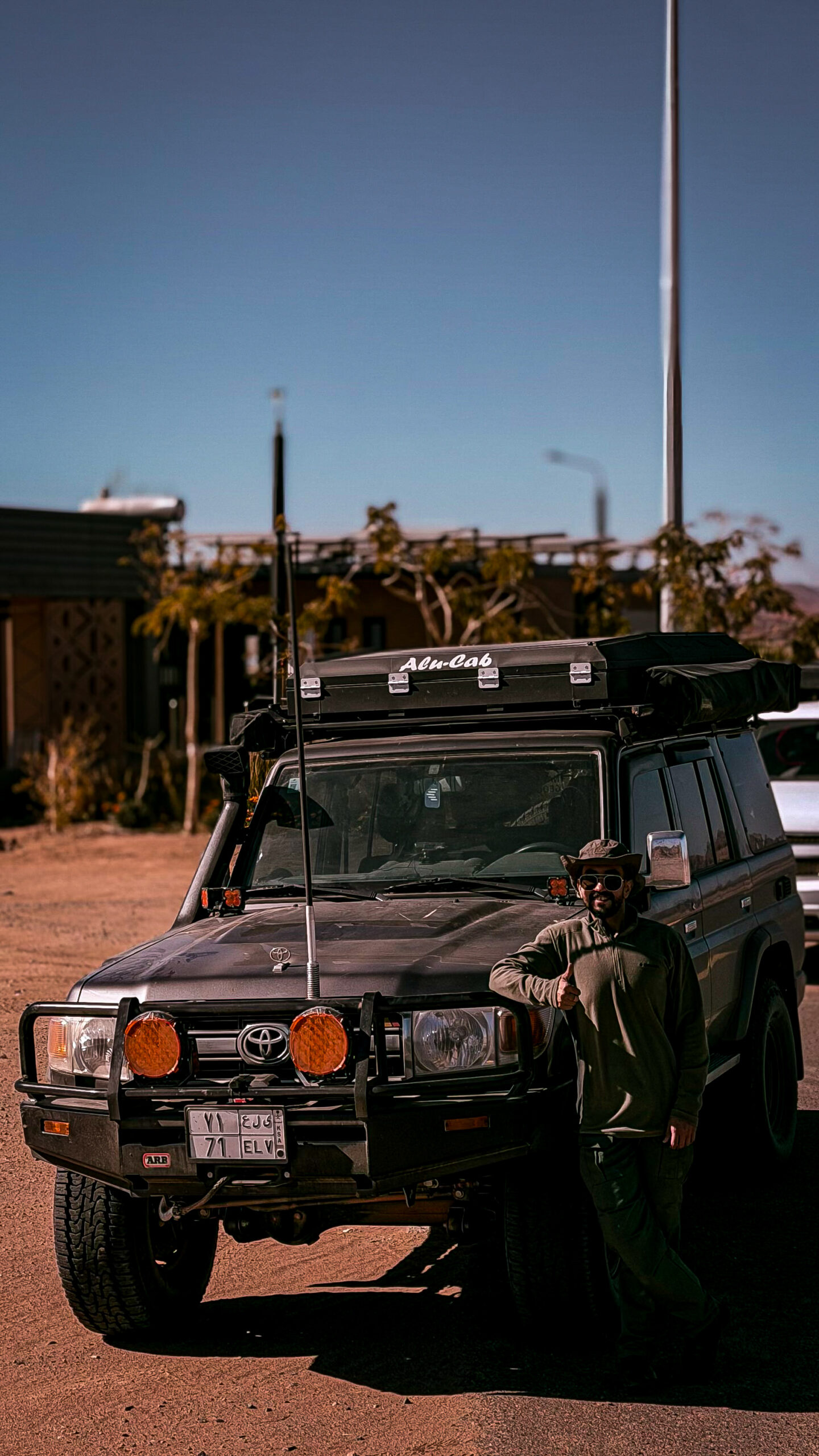
The air shimmers with a heat that feels ancient. An image seen by all those who have traversed this same sea of sand. For many, the mention of Saudi Arabia conjures images of endless dunes. But as the Kingdom opens its doors to the world under its Vision 2030 initiative, a different truth is emerging from the desert haze. This is a land of staggering diversity, and for the overlander, exploring the Saudi Kingdom represents one of the most exciting and unexplored frontiers on the planet.
We recently had the privilege of sitting down with Ahmad Kateb, a Saudi overlander whose backyard happens to be this vast and varied landscape. His journey, his rig and his philosophy embody the spirit of modern exploration in the Arabian Peninsula. Scroll down to discover his story and uncover why Saudi Arabia is the hidden gem of the overlanding world.
Beyond the Dunes
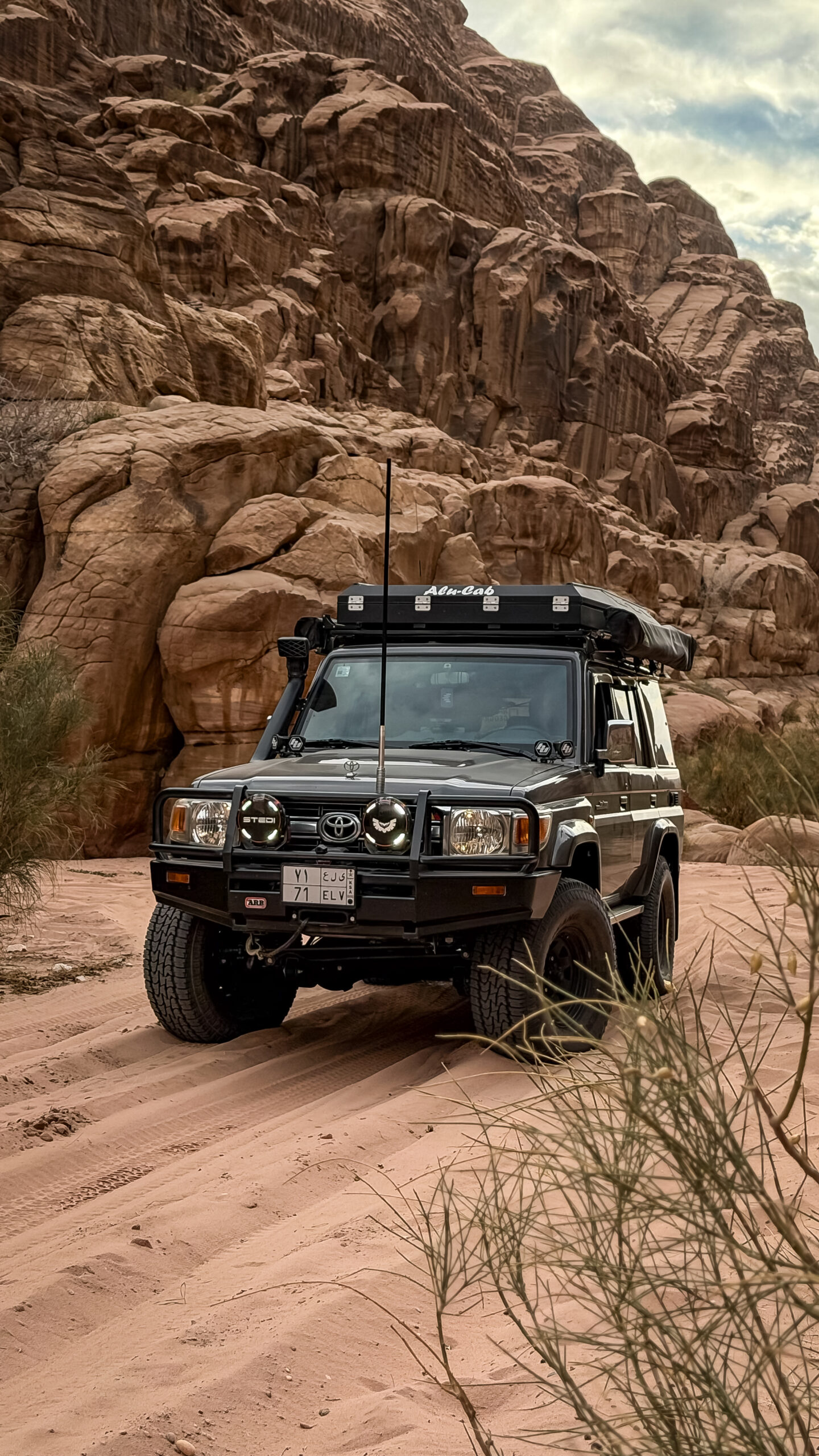
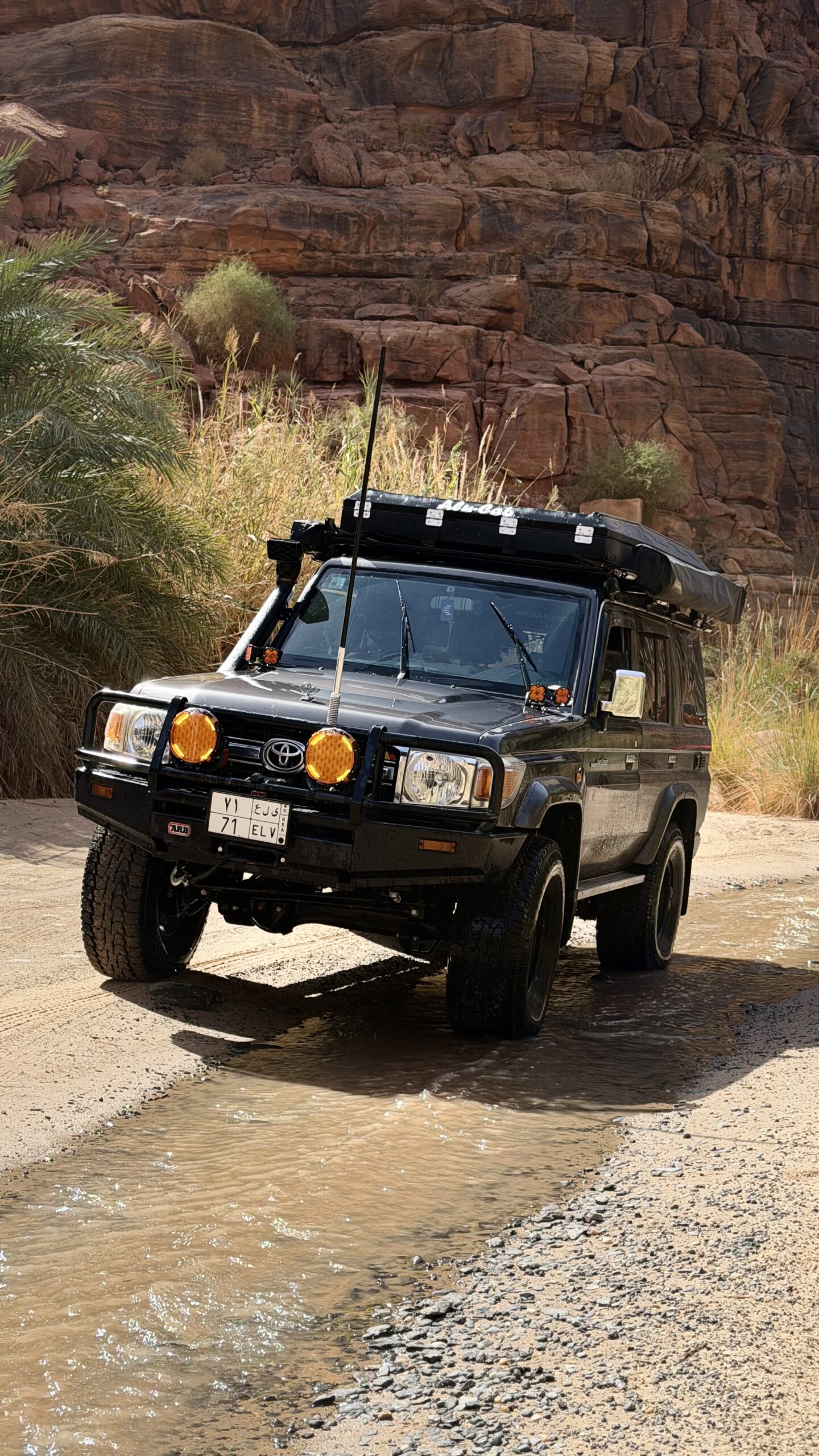
To understand Ahmad’s passion, you first have to understand the landscape on which he bases his adventures. While the Empty Quarter—the largest continuous sand desert on Earth—is a draw for its sheer, overwhelming scale, it is merely a single chapter in a much thicker book. Northwestern Saudi Arabia, where Ahmad spends much of his time, is a geological and historical expanse. The sandstone cathedrals of AlUla, home to the ancient Nabataean city of Hegra, offer a stark contrast to the dunes, with towering cliffs and hidden canyons that hold thousands of years of history. Further north, the oasis of Wadi Al Disah (Valley of the Palms) slices through the mountains, its running streams and lush vegetation a surreal surprise in the arid landscape.
The country’s geography is a mosaic. The rocky Tuwaiq Escarpment, including the famed “Edge of the World,” drops away into ancient seabeds; the volcanic fields of Harrat Khaybar present a desolate, moon-like terrain; and the unspoiled coastlines of the Red Sea near Tabuk offer a chance to air down tires on both sand and shore. This incredible diversity is what fuels Ahmad’s curiosity and dictates the need for a vehicle that is as versatile as the terrain itself.
A Mobile Basecamp for the Elements
For Ahmad, the dream of access to this landscape began with a choice of platform as legendary as the land itself. The Toyota Land Cruiser 76 Series needs no introduction. Prized not for its comforts, but for its near-mythical durability and straightforward, field-serviceable mechanics.
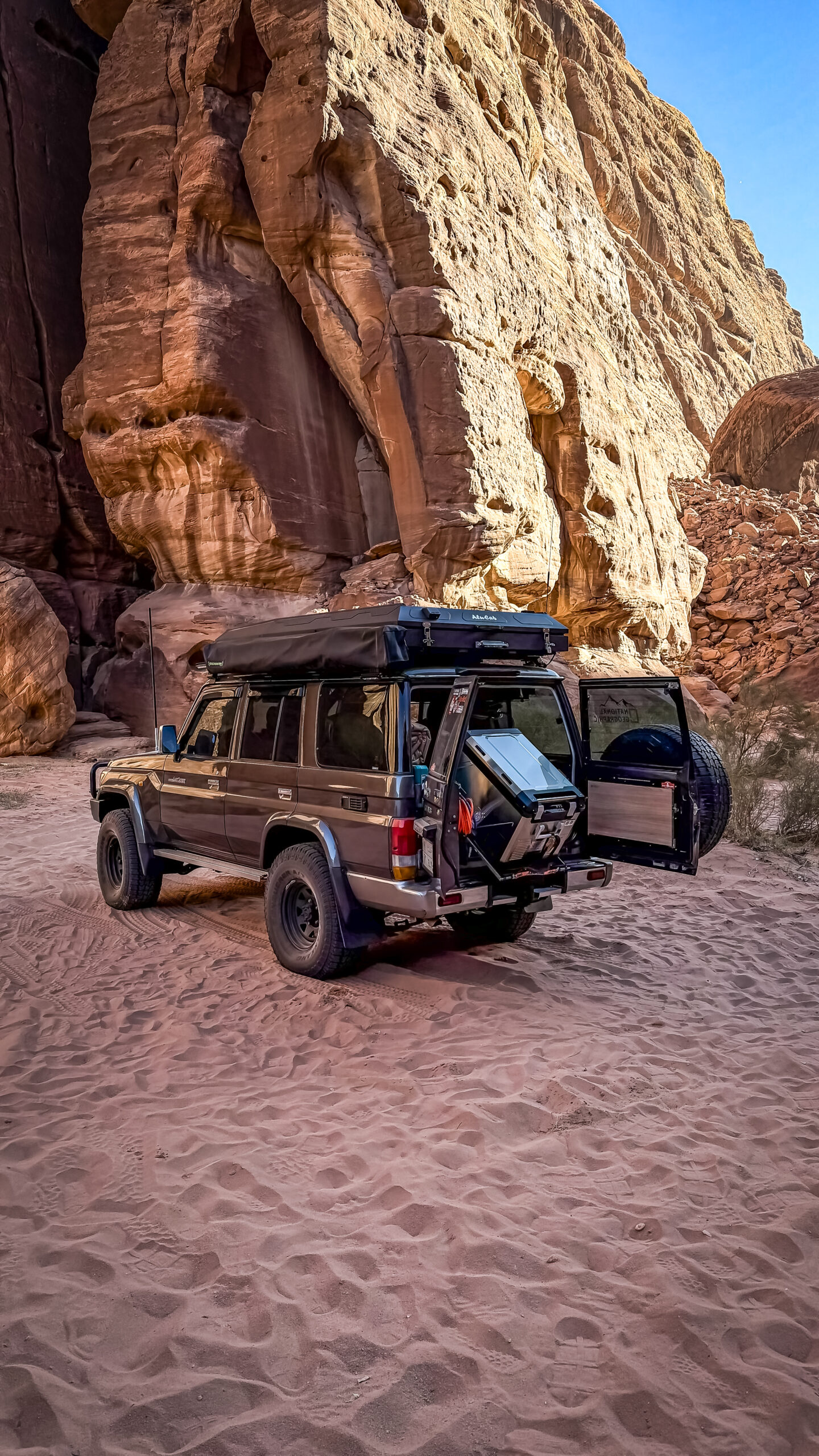
“My adventure vehicle is a Toyota Land Cruiser 76 Series,” says Ahmad. “It’s built for durability, long-distance travel and full self-sufficiency. It’s my mobile basecamp designed to handle the extreme heat of the Empty Quarter, the rocky trails of Tabuk, the mountain heights near AlUla and the coastal environments.”
To transform this capable 4×4 into a true expedition vehicle, Ahmad turned to Alu-Cab, a name synonymous with expedition-proven gear. His build is a masterclass in purpose-driven design. The centerpiece is the Gen 3-R Rooftop Tent and 270° Shadow Awning, creating a swift, secure shelter from the elements. He’s also integrated the LC76-specific window storage box and a Tilting Fridge Slide, proving that intelligent storage is just as crucial as a capable suspension.
“I chose Alu-Cab because of its expedition-proven durability and intelligent design,” he explains. “In Saudi Arabia, conditions shift quickly. Intense sun in the dunes, strong winds across open plains, rocky climbs in valleys like Wadi Al Disah and humid coastal air.”
His “aha!” moment came during a windy night near AlUla. “Camping near AlUla during strong desert winds and realizing how stable and solid the setup remained was the moment I knew I had chosen the right solution.”
Capability, Silence, and the Search for Terrain
Ahmad’s approach to overlanding is a refreshing departure from the quest for reaching a predefined destination. His build philosophy is rooted in resilience: “Capability and durability always come first. Comfort enhances the experience but should never compromise performance. Especially in demanding terrain.” This is a critical point for anyone building a rig for the GCC, where a failure miles from the nearest track can turn an adventure into a survival situation .
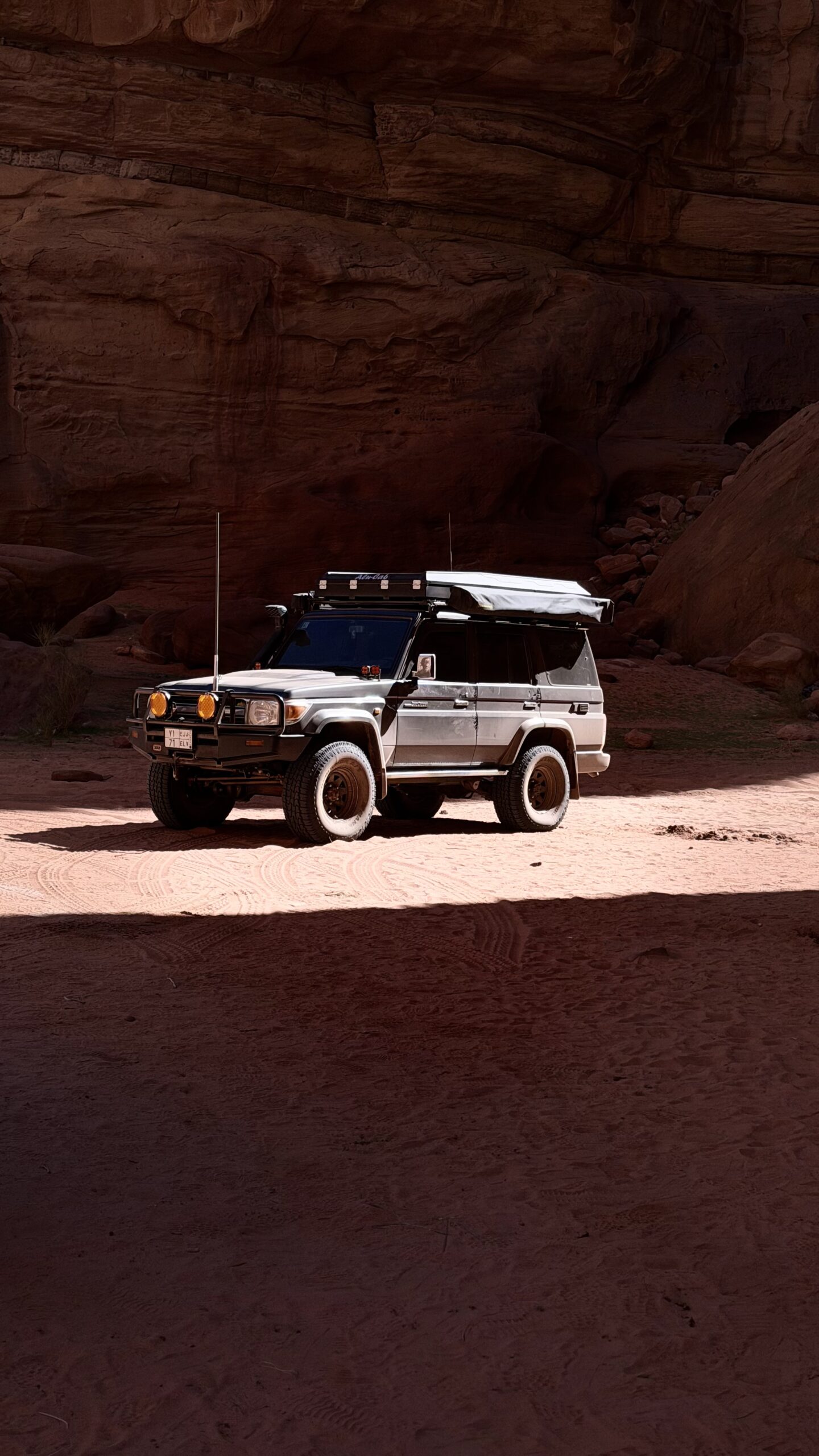
This focus on reliability has freed him to travel in a new way. “It has transformed travel from tourism into true exploration,” he says. “I no longer search for destinations. I search for terrain. Dunes, valleys, cliffs, extended coastlines and protected natural areas.”
When asked what unexpected aspect of this lifestyle has resonated most, his answer speaks to the soul of overlanding. “I didn’t expect to love the silence as much as I do. Whether deep in the desert near Al Zaytah or high in the mountains of AlUla, that silence is powerful.” It is in this silence, far from the noise of the modern world, that the true character of a place reveals itself.
Advice from the Desert
For those inspired to plot their own coordinates on a map of Saudi Arabia, Ahmad offers grounded advice. In a region where the margin for error is slim, preparation is everything. His top tip for beginners is simple yet profound: “Build for your environment and your purpose. Focus on reliability and functionality before aesthetics.” This means understanding your route, calculating fuel ranges across vast distances and carrying comprehensive recovery gear. Monitoring the weather is equally important, as conditions can shift dramatically from desert heat to cool mountain air in a single day’s drive.
He also highlights the importance of the community. “It represents shared knowledge, respect for nature and supporting one another. Both on the trail and beyond it.” This sentiment is echoed by many who travel the Kingdom, where hospitality is a deeply ingrained part of the culture and a helping hand is never far away on the trail.
Whether it was a sudden sandstorm that tested his setup or a surreal night among the cliffs of Wadi Al Disah, Ahmad’s journey is exactly what awaits those who venture into Saudi Arabia’s open spaces. And what’s next for this intrepid explorer? His gaze is set far beyond the horizon. “Driving my rig all the way to Australia and exploring the Outback,” he shares. “Taking the spirit of Arabian desert exploration to another continent’s vast landscapes.” For now, however, there are still remote corners of his homeland to discover, each one waiting in powerful, silent patience.