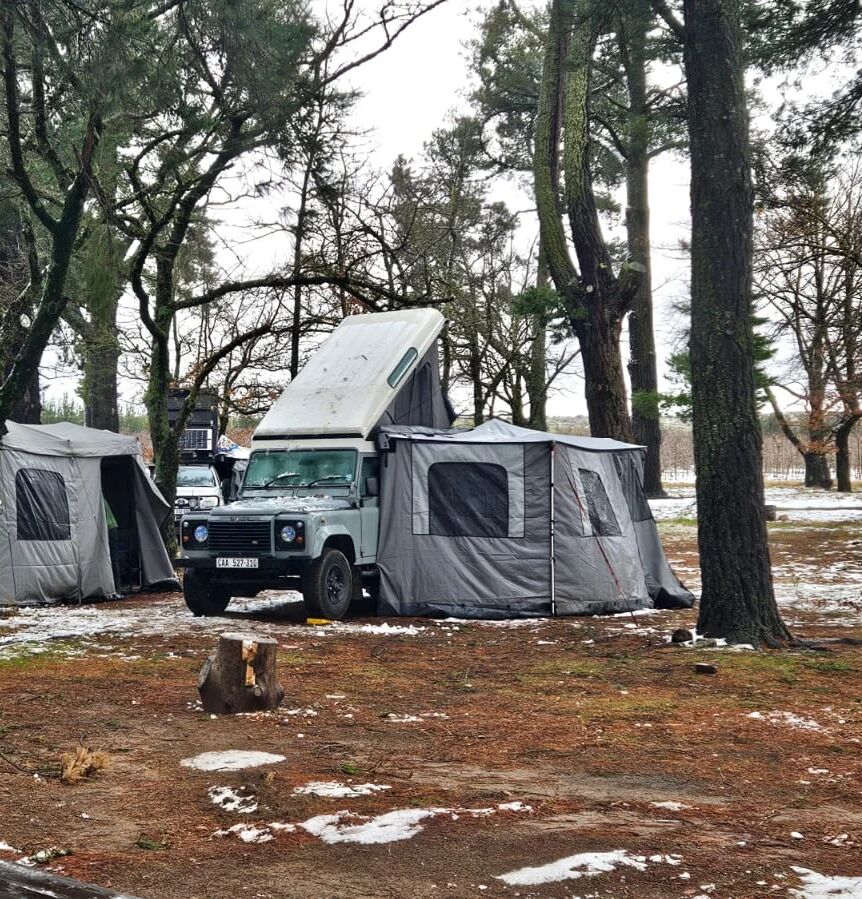
The best gear is the kind you don’t notice. Like our Shadow Awning. And that’s why most awnings get it wrong. You don’t want to have to think about your awning. Instead you’d rather deploy it so that you can eat under it, work under it, wait out an afternoon thunderstorm under it… You simply want to enjoy their protection. They are, as Alu-Cab Head of Engineering Gakiem Fakier explains, the place you spend the most time when camping. Which is why Gakiem and his team have worked hard to make our Shadow Awning better.
Gakiem is Alu-Cab’s head of engineering. He’s also a committed camper who likes to head out in his Defenders (yes, plural) any opportunity he gets. Gakiem and his team has spent years developing and refining the Shadow Awning, and talk about it the way someone who has actually tested it in the real world does. With specifics, hard-won opinions and little patience for vague claims.
“My Shadow Awning is the first thing I open up when I get to a campsite,” says Gakiem. “It gives shade, protection from the sun, wind, rain… It even keeps me warm on a cold night. The fabric we use makes a massive difference in terms of temperature.”
WHY SHAPE MATTERS MORE THAN SIZE
Most people evaluate awnings by square meterage. Gakiem thinks that’s the wrong metric. Or at least an incomplete one. The question isn’t just how much fabric the awning deploys, but what shape that fabric takes when it’s open.
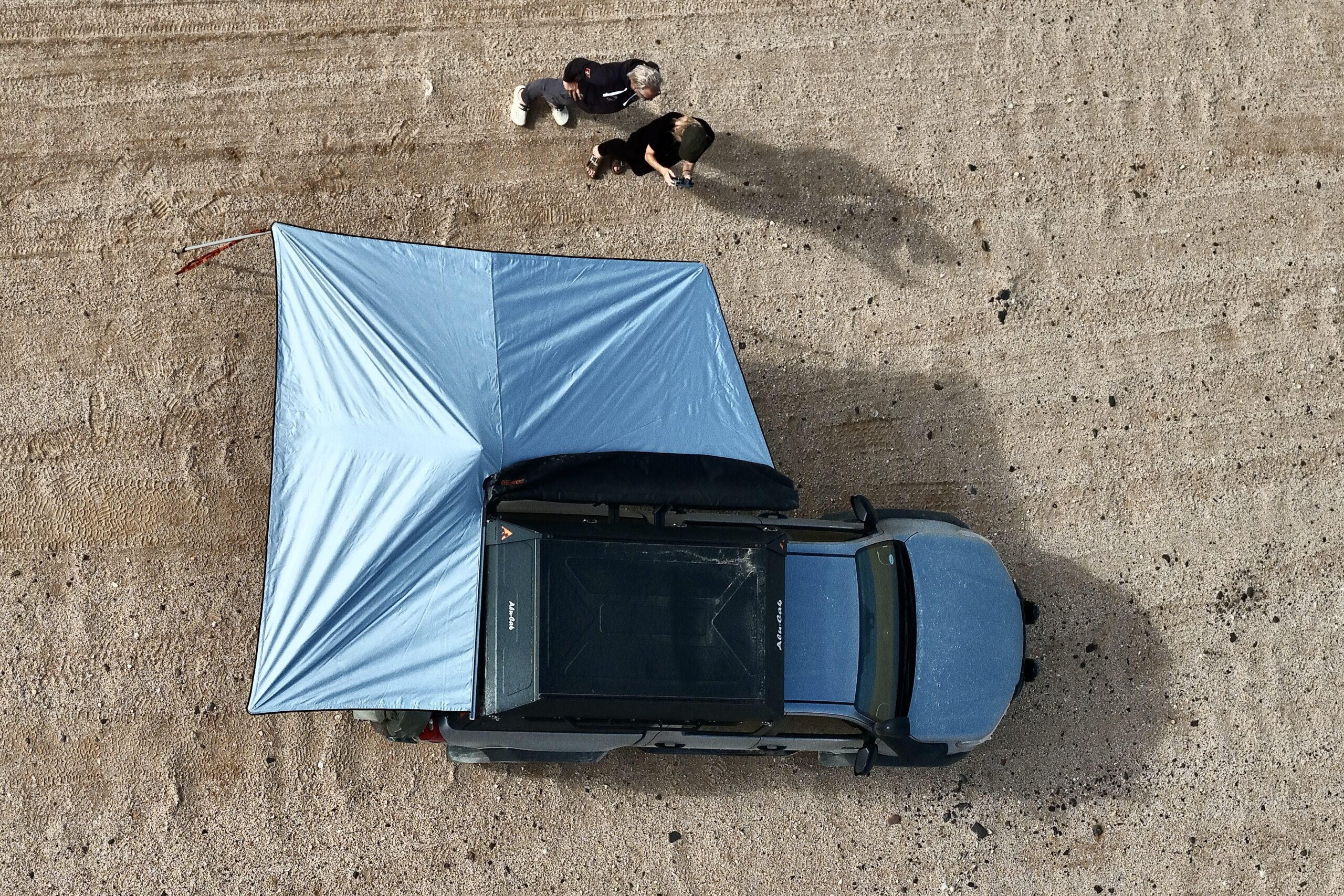
The Shadow Awning’s 270-degree coverage was designed around a single principle: maximise real estate. That’s the usable, liveable floor plan an awning creates around your vehicle. The geometry behind it is more deliberate than it looks from the outside.
“If you stand at the back of the vehicle, you have a straight line on your right, a straight line behind you and a straight line on your left,” says Gakiem. “That’s intentional.”
Where we have engineered straight, flush edges parallel to the vehicle on each side most other awnings have angled lines throughout. The result is that competitors sacrifice meaningful coverage at every edge, and the footprint you actually camp under is never quite as useful as the numbers on the spec sheet suggest.
“I like to put in the time to think and experience the designs,” says Gakiem. “I’m not reactive. There’s a lot of thought, testing and real-world use that goes into every product that we launch.”
Our straight-edged geometry solves this directly. You get a defined working area to your right, full coverage behind the vehicle and a usable zone to your left. That geometry is also what makes the Shadow Awning’s optional side walls and room enclosures work so effectively. The panels attach to clean, straight edges rather than trying to accommodate the angles that haunt competitor designs.
| SHADOW AWNING: COVERAGE AT A GLANCE |
| 270° Model: 10 square metres of usable coverage |
| 180° Model: 7.7 square metres |
| 2M 270° Model: 6.1 square metres |
| Deployment: Solo setup, freestanding, under 30 seconds |
THE ARM SYSTEM
If the shape of the awning defines how much useful space you get, the arm system defines whether that space holds up when conditions get serious. It is the structural skeleton of the product, and where our engineering investment is most visible to anyone who looks closely.
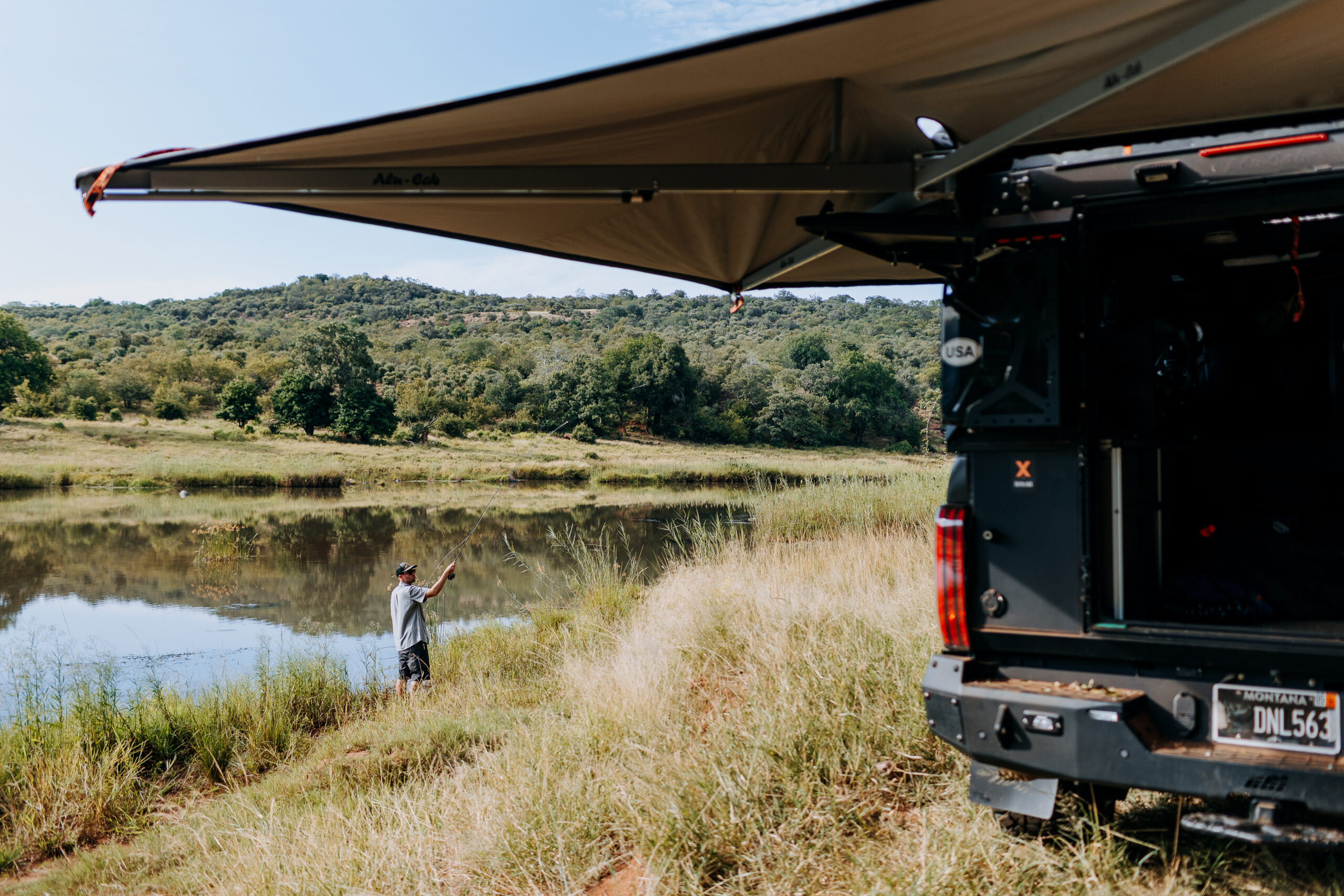
The Shadow Awning uses what Gakiem calls a box section arm design. We developed this in-house to solve a specific problem. How to extend coverage into the rear corners of a 270-degree deployment without the arm losing structural integrity over its length.
“We used two C-channels that overlapped one another and riveted them together,” says Gakiem. “That created a very strong arm that we could extend and get the coverage required, especially in the rear corner.”
The practical implication of this is significant. Most awnings use two weaker arms in that same position. This means they cannot reach the geometry required to square out the full footprint. Which is exactly why their coverage shapes angle instead of square out. Our box section arm makes the straight-edge coverage possible in the first place.
The main pivot bracket is the hub that holds all the arm pivots. Fabricated from 4.5mm 316-grade stainless steel, Gakiem is precise about the choice of material. This is the same stainless steel used in marine and medical applications, chosen specifically because it will not rust under any conditions the awning will encounter in the field. It is tumble-finished and has a distinctive brushed silver appearance.
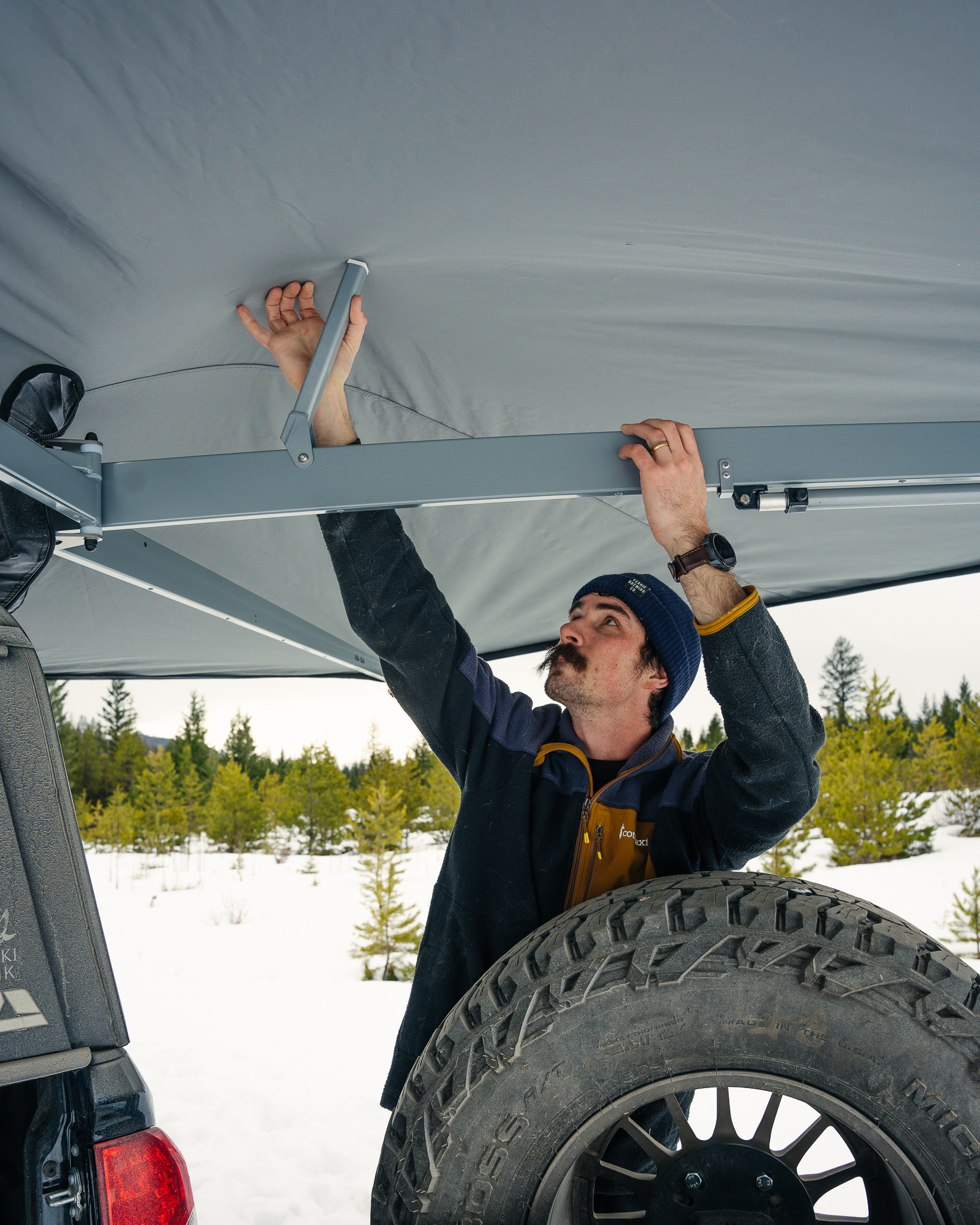
A feature unique to the Alu-Cab Shadow Awning is the tensioning arm. Its function is threefold. It pulls the canvas taut for a cleaner look, it creates a sloped profile that encourages water runoff rather than pooling and it takes up any slack that develops in the fabric over time.
LOAD RATINGS
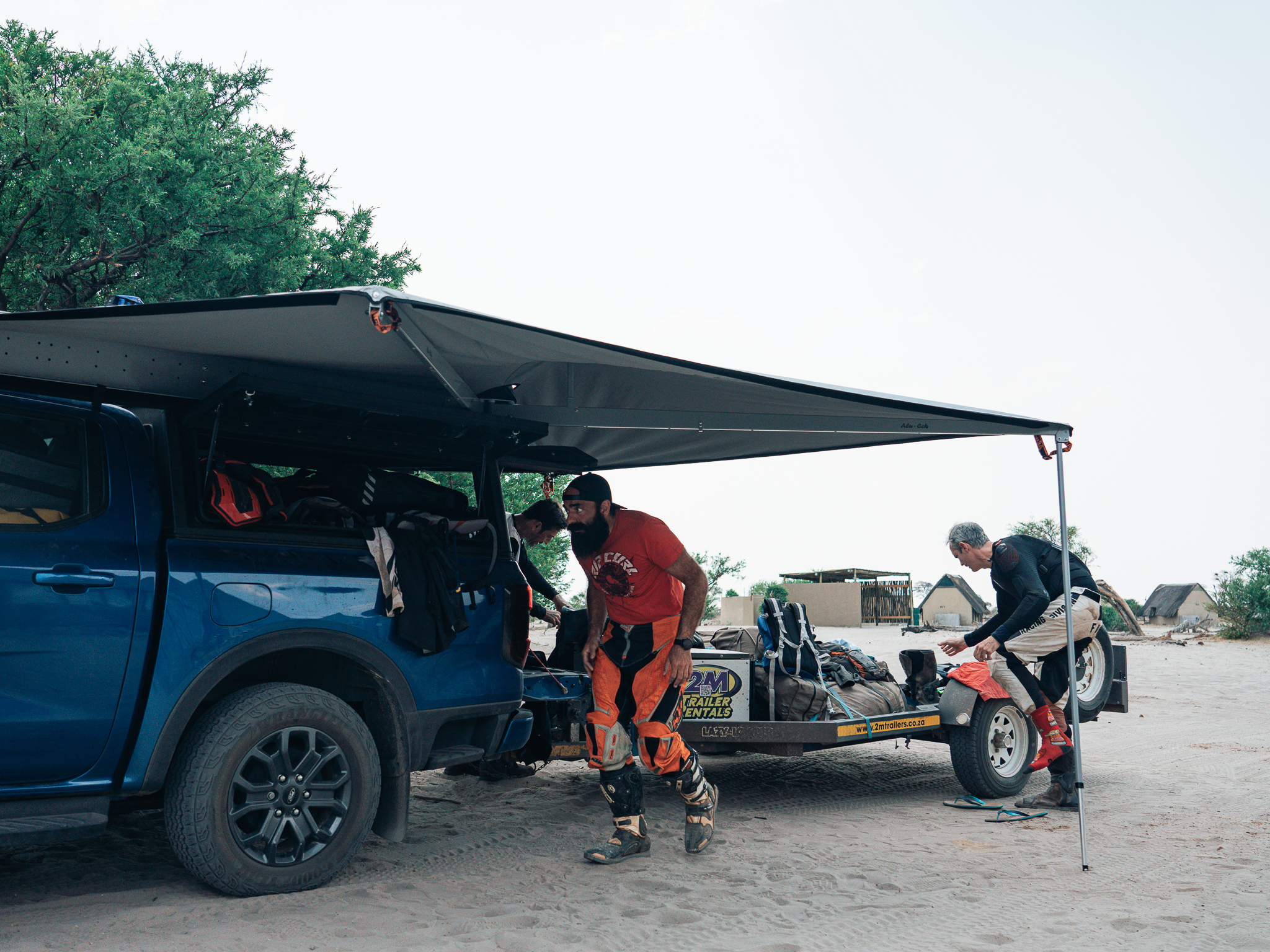
The load capacity of the Shadow Awning is one of its less-discussed engineering achievements. It’s one that becomes relevant the moment you consider mounting lights, a fan or other accessories to the arms.
At the tip of its outermost arm, the awning holds approximately 18 kilograms. That figure increases substantially to around 120 kilograms as you move toward the main pivot bracket.
“At the very tip of the arms, the awning can withstand about 18 kilograms,” says Gakiem. “As you move closer to the main pivot bracket, it can carry up to 120 kilos. You could do pull-ups on there, no problem.”
Here’s something we’ve never made public. When extreme wind turns the awning into a sail, each arm has a designed safety break point — the laser-cut Alu-Cab logo etched into the aluminium. This is the point the structure will yield before any force transfers to the vehicle’s roof or mounting system.
The logo is not just branding. It’s a deliberate engineering decision to protect your vehicle in the event of a catastrophic wind event. It is the kind of detail that does not appear on a spec sheet, but speaks directly to the depth of thought that went into this product.
SILVER COATING, ACRYLIC IMPREGNATION AND WHY IT STAYS DRY
The canvas is the component that separates a good awning from a great one in everyday use. It is what keeps you dry, what keeps you cool and what either performs or doesn’t when the weather turns. Gakiem describes the Shadow Awning fabric with the kind of granular detail that comes from having spent real time with it.
A silver coating aluminises the fabric, the acrylic does the water beading and run off. Then the same principle used in emergency thermal blankets and aerospace insulation, the reflective surface bounces radiant heat back rather than absorbing it, measurably reducing the temperature under the awning on a hot day.
But the silver coating is only part of the story. The fabric also undergoes acrylic impregnation — acrylic worked directly into the canvas weave, giving it a slightly waxy feel. The two treatments work together: the silver layer manages water on the surface, and the acrylic impregnation prevents moisture from penetrating into the fabric weave where it could stagnate and promote mould growth.
The tensioning arm works in combination with the fabric treatment. The sloped profile it creates ensures water is always moving toward an edge and off the awning, rather than pooling in a low spot. On cold nights, the aluminised surface also reflects radiant heat back downward. The same mechanism that makes it cooler in summer holds warmth more effectively than open air.
TOLERANCES, BUSHINGS AND THE CANVAS CONSTRUCTION PROCESS
The Shadow Awning is a more complex manufacturing challenge than a canopy. It combines precision aluminium fabrication with large-format fabric construction. The tolerances on the pivot points where the arms rotate during deployment and what make the Shadow Awning deploy smoothly, every single time.
At each pivot point, we use bushings made from either PA12 nylon or HDPE. Both materials eliminate ongoing maintenance and prevent the metal-on-metal contact that causes oxidation, squeaking and eventually seized pivots. We chose these materials specifically to hold tolerances over the product’s lifetime, from desert heat to coastal salt air.
The canvas manufacturing process is equally involved. We cut the fabric to shape, edge-trim it and fit Velcro channels along the perimeter for Shadow Awning Accessories. We add tie-down loops at structural points. Then we attach the canvas to the housing using a rope mould system. This is sewn into the edge of the canvas, which slides into a C-channel aluminium extrusion on the awning body. It is a clean, rattle-free connection that also makes the canvas replaceable in the field without specialist tools.
We added a centre loop along the longest edge of the canvas. A direct response to real-world feedback. In earlier versions, water could accumulate midway along the span between the tensioning arm and the canvas edge. The centre loop provides a secondary runoff point, channelling water off the awning rather than letting it pool.
A FIRST LOOK AT THE NEXT GENERATION
Gakiem lives the brand. He uses the product he designs. When he says the awning needs a centre runoff loop, it is because he sat under one in the rain and watched water pool where it shouldn’t. When he describes the value of the tensioning arm, it is because he has deployed an awning without one. That direct feedback loop between engineering and field experience is, arguably, the Shadow Awning’s most durable competitive advantage. And the one that is hardest for others to replicate.
We don’t often talk publicly about what’s happening in R&D. But given how much thought has gone into what the current Shadow Awning gets right, we think it’s worth sharing where we’re taking it next. So for those of you who have made it to the bottom of this article, this is your reward…
There’s a redesigned 180-degree awning that challenges the fundamental coverage trade-off between the 180 and 270 configurations. In its current form, the 180-degree Shadow Awning covers 7.7 square metres. The 270-degree covers 10. The 180 XL is being engineered to match the 270’s coverage from a 180-degree format.
The implications are significant. The 180-degree format is the natural choice for overlanders with rooftop tents — because it does not block rear vehicle access — and for vehicles with tailgate-hinged rear doors where a full 270-degree deployment is impractical. Getting 10 square metres of coverage from that format changes the decision entirely.
The arm construction has been redesigned for the 180 XL, with strength ratings approximately double the current model. Where the current awning carries around 18 kilograms at the arm tips, the 180 XL is being engineered to approximately 35 kilograms at the same point.
Next, the Shadow Awning mounting system has been rethought. Moving away from laser-cut hole patterns to a multi-nut slotted aluminium extrusion. This continuous track system allows the awning to be slid and positioned along the mounting surface without removing and re-fitting bolts through fixed holes. For anyone who has spent time fine-tuning awning positioning on a tight fitment, this is a meaningful upgrade.
We are also experimenting with LED lighting that integrates directly into the awning structure, removing the need for it as a separate aftermarket accessory. The lights include a push-clip arm locking mechanism (replacing the current screw-lock design) and a diffused cover to prevent direct glare. A subtlety Gakiem identified from his own experience with prototype versions in the field.
For the existing Shadow Awning range, two new lighting options are being finalised for imminent release. A self-contained rechargeable unit with USB charging, and a 12V DC hardwired option that connects at the pivot point. Both offer white and red light modes and will be available as aftermarket accessories for existing Shadow Awning owners.
MAKE IT BETTER
The Shadow Awning did not get to where it is by accident. The straight-edge geometry is the result of someone standing at the back of a vehicle and deciding the coverage could be more useful. The box section arm exists because weaker arms couldn’t square out the footprint. The acrylic-impregnated, aluminised fabric is the result of asking why water gets into canvas and engineering two separate answers to that question.
Every detail in the Shadow Awning has a reason. And every shortcoming we have identified in the field has a solution in development.
“We can’t stagnate,” says Gakiem. “When the world catches up to our products, we have to innovate. We have to be creative and explore new ideas based on real-life experience.”
That is what Make it Better actually means on the engineering floor. More than a tagline. It’s a brief that Gakiem and his team take literally.